7.3.13

Berlin - Sunday, Day 2 - Breakfast and The Wall (Part One)

Sunday morning we made our way to the Gedenkstätte Berliner Mauer (Berlin Wall Memorial). Before I get to that I wanted to mention this from Saturday night's train ride home.


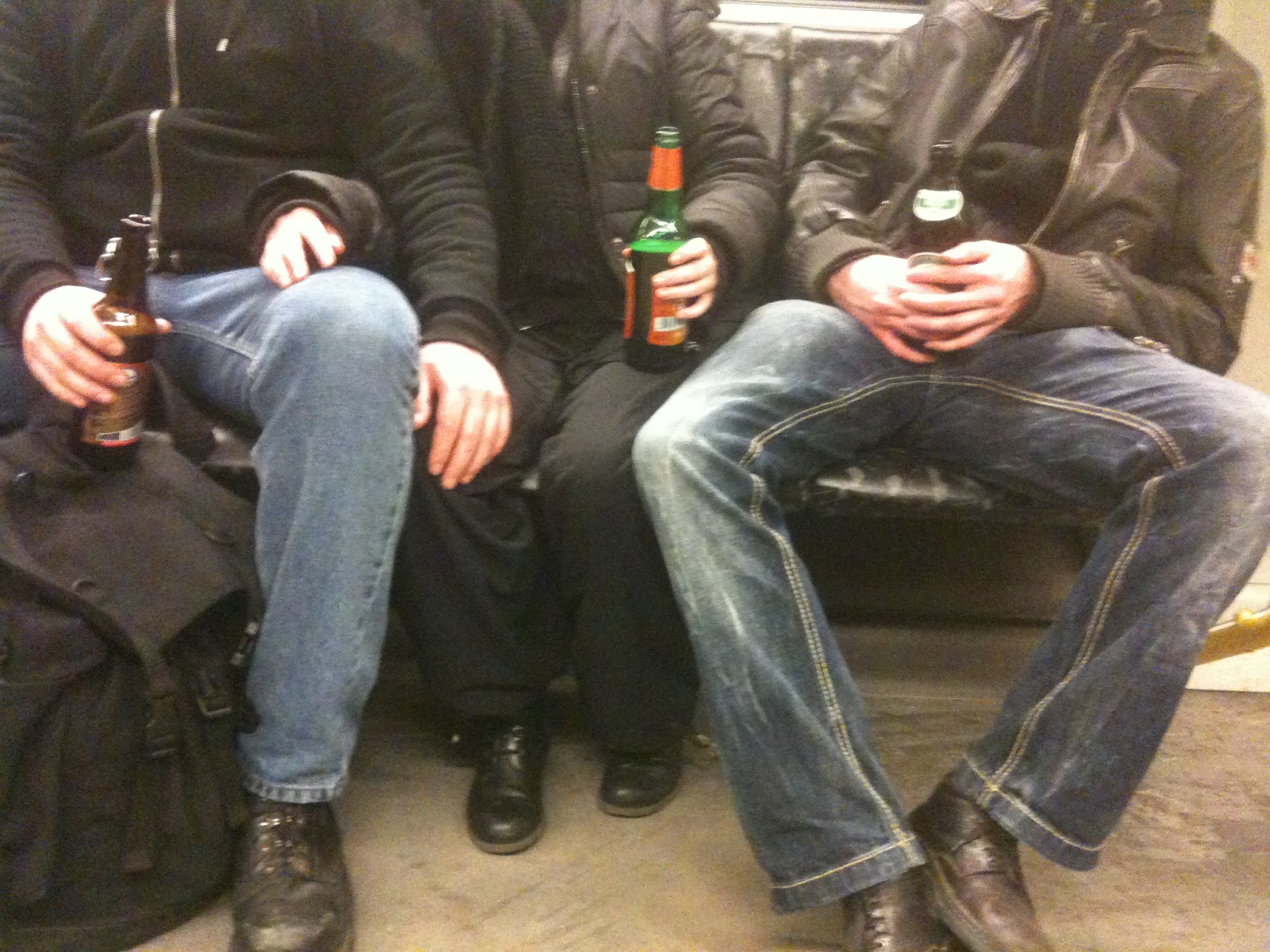
Technically speaking, drinking on the train is verboten. In reality, everyone drinks on the train. People of all ages and social strata. Beer. Bottles of wine. It was surprisingly very much under control. It was still just around midnight - things might get crazier as the night progresses.

Berlin is very much a late night city. 

Anyway, Sunday. We started with a nice breakfast at Schwarzwaldstuben. Cheeses, breads, fruit, jam, yogurt, etc. It was very nice. 


We tried physalis. It looks like a tiny tomato and tastes a bit like a gooseberry. Here's what the leaves look like.


From here it was off to the memorial. Berlin is just teeming with graffiti - both interesting and banal. I'm filing this one under interesting.


The memorial starts with a visitors center. It is connected to an outdoor tower from which you can view the entire memorial along with a closed section of the wall that is as it was during the height of the cold war.


Our vantage point in these pictures is from the west looking to the east. 

Construction began in 1961. Over the next 28 years it would be strengthened, modified, and redeveloped. Now with more death strips! What began as a barbed wire fence became a highly fortified concrete wall surrounding the entirety of West Berlin. The East claimed that the wall's purpose was to curb all western / fascist influence from disrupting the delicate new socialist utopia in the DDR. In reality it was built to stop East Germans from defecting to the west through West Berlin.

In the years leading up to the construction of the wall, 3.5M East Germans defected to the West. West Berlin was a natural jumping off point as it was by far the eastern-most point of western departure for any East Germans wishing to leave for the west. After the wall was built, around 5,000 attempted escape and approximately 600 died in the process.

Now I'm going to break away and pull out my virtual soapbox. I apologize, but I can't - in good conscience - talk about these things without addressing my feelings on the importance of these walks through history. Much of the historical aspect of this trip highlights two main points for me. One, man's astonishingly hideous inhumanity to man. Two, man's collective failure to learn from the horrors of the past. We keep doing the same things over and over again in the name of decency, freedom, exclusion, security, paranoia, and / or country. And when we do those things we forget about real decency, tolerance, and humanity. It depresses me. It makes me angry. </soapbox>

Okay, the wall memorial. Inside the visitors center is a great picture / news clipping / document center highlighting the construction of the wall, attempted escapes, and the political climate during the various periods of the cold war. It is fascinatingly complex and I can't even hope to try to explain the effects of world events on the construction of the Berlin Wall and the Cold War in general. 

This is just such an amazing period of history. So many important intertwined events and actors. This trip actually makes me wish that I had taken more time to learn post World War II history. It's never too late!

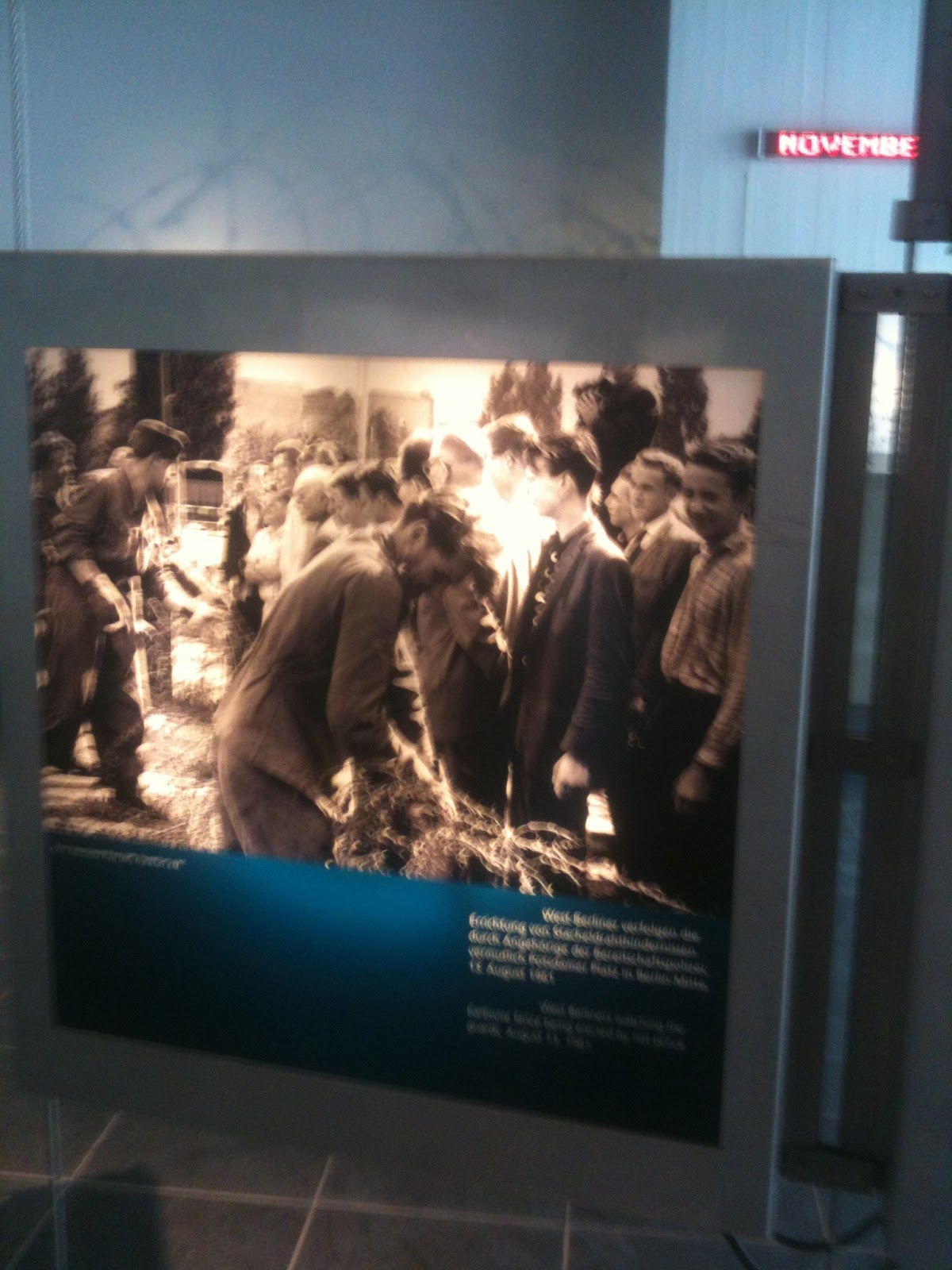
Below is a picture of West Berliners watching - with smiles! - the construction of the first wall.

And here's Checkpoint Charlie with American tanks on one side and Soviet tanks on the other.


The "death strip" in this section of the wall has been transformed into the current memorial. 


This death strip area was originally part of a cemetery. The East Germans removed the stones, and paved over and / or disposed of the bodies. Today there are several crosses commemorating these displaced graves.

Originally, the wall was actually interspersed with buildings in this area. When it was built, the windows and doors were bricked up. Like this.


There are pictures of the final moments with people jumping out of windows to escape. It's heartbreaking. Eventually the DDR destroyed most of these buildings in the successive redevelopment of the wall.

In 1985 the DDR destroyed the Versöhnungskirche, again in the name of security.


I'm going to close with another interesting aspect of life in post wall Berlin. Ghost stations. An odd quirk of the Wall is that there were U-bahn and S-bahn lines connecting various points in West Berlin that ran through small portions East Berlin. West Berliners could travel on these trains, but the trains did not stop in the East Berlin stations - except at Friedrichstraße where travelers could transfer from the U6 to another S-bahn line without leaving the station. The trains would slow down but not stop - there were heavily armed DDR guards  standing at attention in very low light at each of the ghost stations. 

West German rail maintenance had no access to the tracks in East Berlin. If a train broke down the passengers would have to wait for DDR guards to escort them back to West Berlin. Other tunnels were blocked, entrances were closed or disguised as guard boxes, and motion detectors were placed in the stations and tunnels.

As always, I'm sorry if there is any incorrect / missing info here. I am not a historian. These are also my thoughts and don't reflect those of anyone else other than me. Many of the pictures were taken by either Emily or I. The rest were snagged from the internet. Thanks to the following - non-Wiki - sources.


Next up; Collin, Emily, and Christoph visit the Computerspiele Museum.

5.3.13

Berlin - Saturday, Day 1 - Stasi, Pho, and Spätzle (or Knödel)

The Stasi Museum is a very weird, amazing place.

The Stasi were the secret police / intelligence agency / state security arm / "Shield and Sword" of the GDR beginning in 1950. In many ways they were an extension of the KGB. It was an agency styled after the KGB and guided by Moscow. The main goal was to collect information on dissidents, and quiet them in any way imaginable.

The museum is hard to find and barely looks like a museum. We came up Ruschestraße and nearly missed the entrance. There's a decrepit yellow concrete pylon printed with "Stasi Museum". It's fitting.


The museum lies in the most important building of the Stasi compound in Berlin.


This is where Erich Mielke held his office and commanded the Stasi.

The Stasi combined paranoia and bureaucracy in a completely insane and structured way. Check out these jars.


You guessed it, it's the "scent" wiped off the sat-in chairs / sofas / couches of dissidents! Here's the checklist.


I suppose that this was to be given to dogs to smell. Said dogs were then brought in to identify the dissident in question. Dissident identified! I love the idea of shelf after shelf of jars in some East German basement.

The GDR collapsed after the removal of the wall in 1989, Mielke's office looks today as it did then.


I stress that this was 1989.

After the fall of the GDR, the people of East Germany stormed the Stasi compound seizing documentation that the Stasi hadn't already shredded. Poorly. Today, the spied upon can view their non-obliterated Stasi files.

The museum covers the propaganda, the observation devices, and the paranoia.


The car is particularly impressive. The panels in the door included IR emitters to allow cameras to capture images at night. Only 25 were made and they cost 200,000+ marks per car - the working class East Germans earned in the neighborhood of 1200 marks per year.

And here's Collin outside the museum.


Next it was off to Dong Xuan Center for Vietnamese food and browsing. So many things. There are several long warehouses full of "stuff". Each warehouse looks pretty much like this.


Clothes. Possibly bootleg DVDs. Fake flowers. Knick-knacks. Shoes. Toys.

I had some tasty pho, mostly digging the super spicy accouterments - some nice "thai" chiles and an awesome garlic thing. It was a good time. As will be a theme of this trip, we should have spared some room for souvenirs.

Next back to the hotel and on to meet Christoph et al at Spätzle & Knödel. Super fun casual German food and tasty beer. Emily and I both rolled with the Schweinebraten mit Schwarzbiersoße und Bayerisch Kraut - slow roasted pork with sauerkraut. We went with Knödel over Spätzle. Knödel is a sort of German dumpling. Christoph selected a mix of dumpling. Just an awesome sauerkraut. Good times.

I don't think that northern Germany is much known for its food - this could be because I hung with Bavarians all weekend, but who knows. I had a tasty meal, but I'm sure it would be better in Munich. Specifically the pretzels.

Next up, Collin and Emily check out the wall memorial and Christoph and Collin face off on the Painstation.

Berlin - Saturday, Day 1 - Journey / Arrival


As you may or may not know, Emily and I took a quick trip to Berlin this weekend to belatedly celebrate my birthday. I'm going to recap the trip over the next couple of days, attempting to capture and explain as much as possible as we go along.

To put it simply, Berlin is a fascinatingly complex city. It is the largest city in Germany. The capitol. Berlin is at once a city rebuilt from the ashes of the second world war, divided in half, and then reunited and rebuilt again. It's a place brimming with history, funky people, and cheap food. In a few words, Berlin is Collin's kind of city.

Here we go.


Thanks EasyJet! Emily and I pulled this off for $160 total round trip for the both of us. We even had reserved seats! The flight out took - and I'm not exaggerating - twenty-five minutes. Huzzah.

Things took a bit of a turn for the worse when we tried to get from SXF (Berlin Schönefeld Airport) to our hotel downtown. Schönefeld was the only airport serving East Berlin during the GDR era and, as you can imagine, it was predictably neglected and still feels rather East German. Sooo many stairs.

We knew that we would need to take a regional train - either the RE14 or RE7 - to get to central Berlin. Berlin's mass transit system is split into three zones - A, B, and C. You can buy tickets or day passes for A-B, B-C, or A-B-C. Schönefeld is in zone C. Nearly every part of Berlin that the average tourist would visit sits in A-B. An A-B-C single ticket costs €3.10. An A-B or B-C ticket costs €2.40. For reference, a day pass for A-B or B-C is €6.50 and the A-B-C pass is €7. 


The nice thing is that any ticket covers you for any type of public transit - bus, tram, U-bahn, S-bahn, and regional train. Just frank your ticket in one of the red or yellow boxes and hop on your choice of transit. You have 2 hours to finish your journey, on the same ticket. The system is far reaching and super convenient. It's the best transit system I've experienced thus far.

So on to the bad part. There are kiosks where you can buy tickets - with an English option! The yellow kiosks - typically in U-bahn stations - take limited non-coin cash and have limited credit / debit options. Our bills were too big and our dankort was useless.

We pressed on into the station where we thought the train might be. There were other kiosks - red ones - and these accepted our dankort. Win. The next step was finding the correct platform. Almost nothing in the the Schönefeld train station is labeled. There are platform numbers, but that's about it. Luckily, we had iFahrinfo. It's a great Berlin mass transit app with pretty much the same engine that the rejseplanen app uses. I checked things out when I was still at CPH, and thankfully the app listed the platform number. Additional fact, Danish phones only work in Denmark, unless you feel like roaming.

So there was the train at platform 1. Waiting. No labels. Nothing. We took the leap that it was the right train and hopped on. Success!


Stay tuned. Next, Collin and Emily arrive at their hotel and make their way to the Stasi Museum to meet an old friend. It's Herr Domann!

1.3.13

WotD #19 - Ost

Ost. Sweet, delicious ost.


At the top that's a french brie and at the bottom, there's a danish blue.

I will enjoy these with my ost.


WotD #18 - Gift

Emily og Collin er gift. De er gift.

Emily and Collin are married. They are married.

To pronounce it...

og is like oh
er is like air
de er is like dayyy
gift is like geeft

Let's hear it.


Rather sweetly, in Danmark, marriage is a gift.

DotW #9 - Asger Jorn

Asger Jorn, 1914-1973


Painter, sculptor, ceramic artist, and author Asger Jorn was born in Århus, Denmark on the 3rd of March in 1914. Århus is the København of Jutland and is Denmark's second largest urban center.

Both of Jorn's parents were teachers and devout Christians. His father - a fundementalist - died in a car crash when Asger was 12. Asger contracted tuberculosis at 15 and would palindromically contract it again at 51. At 16, Jorn enrolled in a teacher training college, despite the fact that he already had an interest in painting. While at Vinthers Seminarium, Asger became more and more interested in philosophy and art. He also joined the Danish Communist Party.

After college Jorn left for Paris to study / further evolve. He began to move away from figurative art towards the more abstract art he would be known for.

During WWII, Jorn participated in the Danish communist resistance movement against German occupation. In a later post we may get on to the occupation of Denmark, but let's just say that the Germans saw Danes as brother-people and treated them - even in occupation - as such.

With Guy Debord he participated in the early artistic years of the Situationist International. Throughout his life, Jorn remained a revolution-driven-philosopher, railing against capitalism and its effects. In 1964 he was awarded a Guggenheim Award. This was - by telegram - his response.
GO TO HELL BASTARD--STOP--REFUSE PRIZE--STOP--NEVER ASKED FOR IT--STOP--AGAINST ALL DECENCY MIX ARTIST AGAINST HIS WILL IN YOUR PUBLICITY--STOP--I WANT PUBLIC CONFIRMATION NOT TO HAVE PARTICIPATED IN YOUR RIDICULOUS GAME.
Jorn's work is varied. Here is my favorite piece from the Lousiana.


Here's a random scattering of other stuff.


And here's Asger at work.


Day 74 - Taking what they're giving

cause - like Huey - I'm working for a living.

Today I accepted a temporary - until November - technician position at Novo Nordisk in Måløv. I will be working in an antibody production / purification / characterization lab. I have to work out the details, but I'm fairly certain that I'll start next week - as early as Wednesday.

It will be good to start working again. Staying busy is a huge plus.

I will need to change my language class at VUF - I'm currently on M / T / TH / F from 12-15, but they also offer night classes. I really like my TH / F teacher Camille, she has been very helpful.

Today I used Danish - er dansk - for the first time in a public setting! At the ost shop down the block. Jeg taler ikke dansk. It sounds like ya TAIL-er igg dahnsk. It means I don't speak Danish. Baby steps.

Tomorrow we're off to Berlin. Pictures and details forthcoming.